
Northern Sweden shows the world how to implement remote virtual healthcare
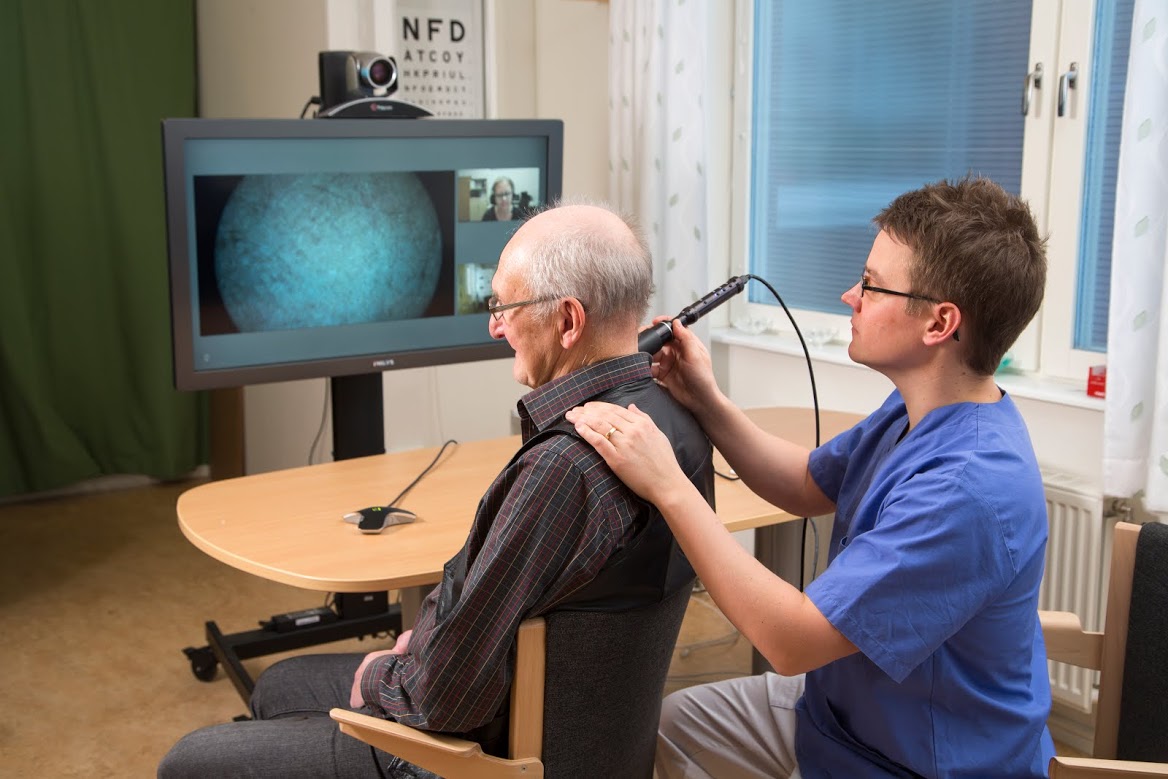
Public stakeholders in Northern Sweden have joined forces with Nordic Health Innovation (NHI) to support a collective ambition with the aim of becoming world leaders in the field of future health and social care in rural areas. This plan includes an extensive initiative relating to virtual health rooms in cooperation with municipal healthcare services. Three such health rooms have already been established, and more are in the pipeline.
In many countries all over the world, rural medicine is a high priority area undergoing extensive research. Sweden’s only R&D department specialising in rural medicine is situated in Northern Sweden, where just under 300,000 people now live in rural areas. This area also has the highest proportion of elderly people and the highest dependency ratio. If this area continues to develop as is currently the case, researchers expect there to be more people of non-working age in Sweden’s rural municipalities than people of working age by the early 2030s. This is a development which will significantly increase and alter the need for healthcare and medical services, but also the chances of recruiting well-trained care personnel.
Against this background, NHI has joined forces with regions and municipalities in Northern Sweden to support a collective medical services policy plan and an ambition with the aim of becoming world leaders in the field of future health and social care in rural areas. This ambition includes continued development of the virtual health rooms in cooperation with municipal healthcare services. The aim is to have at least 20 or so similar virtual health rooms in the four northernmost counties within two years.

A good testbed arena
The inland municipalities in Northern Sweden have a temporal advantage on account of the skewed age structure of the population, where between 25 and 30 per cent of residents are over the age of 65. In some municipalities, more than 10 per cent of the population is over the age of 80. “In this respect, we are approximately 25 years ahead of the rest of the world. In inland areas in Northern Sweden, therefore, we have a unique opportunity right now to test medical technology products, working methods and processes of various types on an existing population with an age structure which will be reality in many countries in 25 years’ time. This demographic advantage, combined with one of the best developed, high-quality broadband networks in the world and cohesive, high-quality patient case note systems, provides outstanding opportunities to test innovative new solutions in the care and medical services sector,” says Peter Berggren, Head of the research organisation GMC (Centre of Rural Medicine) and one of the founders of NHI (Nordic Health Innovation).
“Our ambition is for Northern Sweden to provide a good testbed arena for rural medicine and distance-spanning methods,” he adds. “We have to turn our demographic lead to our advantage. We are aiming to devise hot products and services which will help us to live longer, healthier lives at home, while the same time aiming to provide care in people’s homes to a greater extent.”

Focusing on virtual health rooms
The expansion of virtual health rooms is one of the most important initiatives in Northern Sweden relating to rural medicine. At present, a virtual health room is a customised, unstaffed health room with the aim of staying open 24 hours a day for recipients of care in rural areas. It will also be possible to install the virtual health rooms of the future in people’s own homes or on their mobiles. If necessary, doctors will be able to connect to these rooms via video links, and the rooms will be equipped with a range of devices. All local residents will be able to go into one of these rooms and check their blood pressure and take blood, blood sugar and warfarin samples. These devices will be interlinked with district medical officers’ case note systems and medical services case note systems via a central server.
“This will be a self-service facility where people can easily screen themselves and make initial contact with a doctor,” says Peter Berggren of NHI.
Award-winning founders
Nordic Health Innovation (NHI), a company with 20 years’ practical experience of remote technology and virtual healthcare in extremely rural areas and which has been developed in close cooperation with the research organisation GMC (Glesbygdsmedicinskt Centrum, the Rural Medicine Center) in Storuman, is responsible for the launch of the virtual health rooms. The founders of NHI are brothers Dr Peter Berggren and Jonas Berggren. Last year, Peter Berggren won the Guldskapellen Swedish Medical Care Innovator of the Year award for “the courage to try new ways of operating and organising primary care through innovative approaches, new technology and a broader perspective on the living conditions of people in rural areas”. That same year, Jonas Berggren won the prestigious Swedish Stora Produktivitetspriset Award in his capacity as CEO of the rapidly growing SSG (Standard Solutions Group).
NHI offers flexible, cost-effective and standardised virtual health rooms to public and private customers with the aim of helping to improve quality of life and increase accessibility even for citizens living in extremely rural areas who are a long way away from doctors and other medical care specialists.
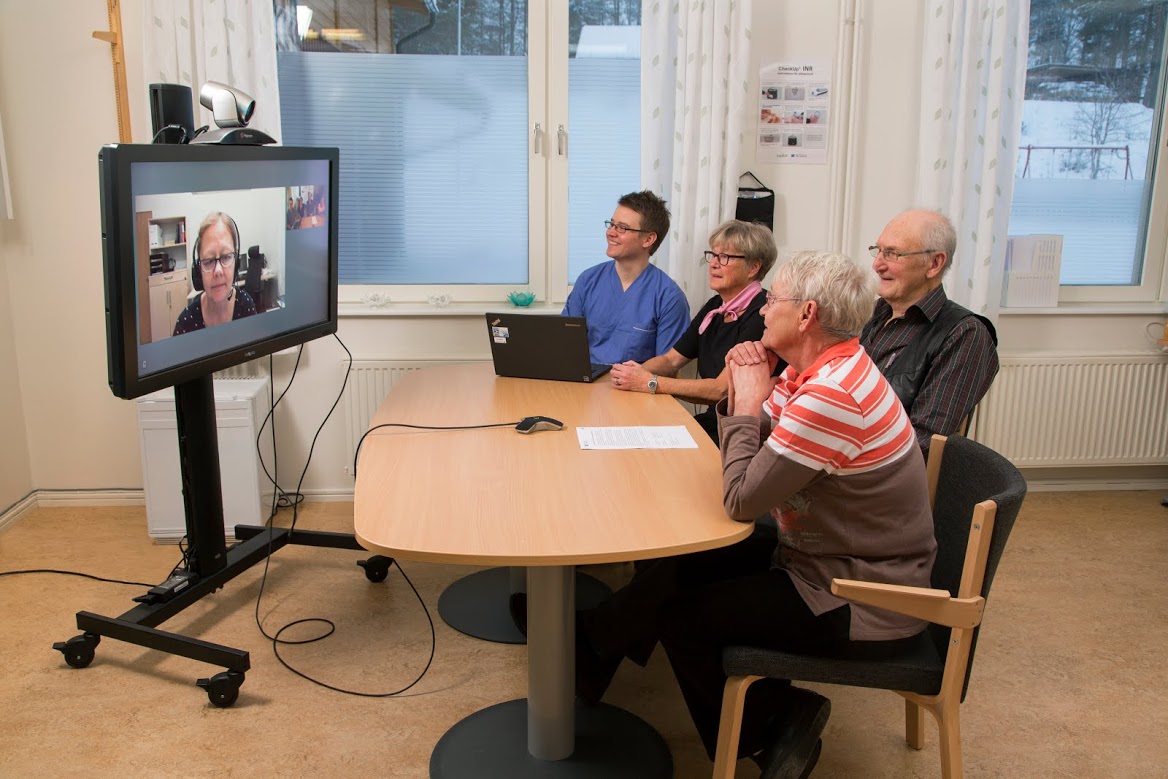
NHI’s health rooms
To date, NHI has built up virtual health rooms in the villages of Slussfors and Gällö in Northern Sweden. The next health room is planned to open in the village of Stugun in the autumn. “For us, these virtual health rooms are a deliberate strategic initiative. With distance-spanning methods, we can ensure that we achieve good, effective healthcare and medical services, while at the same time ensuring that patients do not have to travel as far. These complement the health centres, relieving pressure on them and increasing availability as the health rooms have much better opening hours than standard health centres,” says Björn Eriksson, Regional Director for Region Jämtland Härjedalen.
The health room in Slussfors in the municipality of Storuman has been in use for almost two years now, with very good results. The health room is situated close to the school in the village, with keys and the staffroom for the home help service, offering access to assistance and trained personnel.
“Slussfors is a pilot facility, and we have had the opportunity to try out and develop various devices and ideas here. The health room in Slussfors is working well, and the municipality and medical services resources work together there to help patients with samples if so required,” says Peter Berggren of NHI.
83-year-old Carl-Axel Nordenberg, who was part of the health room’s reference group, has also found the health room to be positive. “It is 50 to 80 km to the nearest health centre for the people living here in the area. Slussfors is just 10 or 20 km away. The health room is extremely valuable for those of us who need a quick initial consultation with a doctor via a link and access to blood pressure readings and blood samples, and it offers us a high level of security. I know of at least one person who discovered that she had diabetes without knowing about it thanks to the health room,” he says.

Focusing on innovations in training
NHI and the Rural Medicine Center are now investing major resources in the further development of the virtual health rooms, together with their partners and customers. These initiatives include remotely controlled cardiac ultrasound using robotics, planning and dimensioning tools for support care and medical services, and an app for diabetics which enhances security for adults and children alike.
“We can make the virtual health rooms as good as we like – the only limits are in our own imaginations,” says Jonas Berggren, Chairman of NHI.
Training initiatives are also important for ensuring that skilled assistance is always close at hand to the health rooms. “In Gällö in Jämtland, for example, we have launched a training course where municipal home help staff can learn all about the equipment found in the health room. We are also focusing on a self-learning system where residents and relatives can teach one another to use the equipment. We face a major challenge here, because the diagnostic equipment available at present is designed for use by care professionals, not by users. We have to design simple products which can be understood and used by anyone while at the same time safeguarding the diagnostic security required by healthcare and medical services,” says Jonas Berggren of NHI.
“Standard manuals are not always the best tools,” adds Peter Berggren of GMC. “Here, we are considering simple 3-D instruction videos instead.”

A separate, unique information exchange
Further building up, refining and streamlining the digital doctor service is another initiative high up on NHI’s focus list, as is guaranteeing and streamlining information management to and from care providers’ primary medical data and case note systems. Not least, this is taking place in close cooperation with NHI partners Microsoft, Sigma IT Consulting and Cambio. Cambio is one of Sweden’s leading stakeholders in the field of medical services systems, while Sigma is a leading Nordic supplier of innovative and effective IT solutions based on IoT and the cloud. Microsoft’s bold ambition to re-invent productivity and business process aligns very well with this initiative.
“We are now working together with Sigma, Microsoft and Microsoft Azure technology to build our own flexible exchange which is being designed to integrate our information from NHI and the Rural Medicine Center with the Swedish hospital healthcare case notes system and the newly formed Swedish e-health account HälsaFörMig. With the e-health account, the intention is to gather all information on an individual’s health in a single location which is private and accessible to that individual him/herself. The aim is for this to work as a public health service which makes it possible for people to review their own health information both historically and at the present time, but also to share this information with medical services and research,” says Jonas Berggren.
The service will be cloud based and the Microsoft servers are located within the European Union. Security and data privacy are key contractual and architectural elements and the setup will need to fulfill the Swedish and EU requirements in the area.
Major gains and significant effects
There are many social benefits to be gained from virtual health rooms and technology which is not dependent on distance.
“We will see a clear improvement. Accessibility for residents is one of the benefits, as well as taking services out to patients and reducing the cost of travel and transport. Several million kronor are spent on medical travel in our region alone throughout the year. It will also provide us with an interface for cooperation and implementation of new concepts and innovations,” says Björn Eriksson of Region Jämtland Härjedalen.
Jonas Berggren of NHI agrees. “The region stands to gain a lot by ensuring that the people who really need medical services are also the people who can access those medical services. It may not be possible to replace all visits to the doctor with a virtual health room, but many visits can indeed be replaced.”
The cost of travel and locum cover are some of the biggest expenditure items for the regions in northern Sweden.
“We recently carried out a health economics study as part of an EU project in which we looked at self-service units where patients could turn up and take their own blood pressure and blood samples. The results showed that there was a rapid return on investment (ROI),” says Peter Berggren of GMC.
“Investing in these virtual health rooms is a vital step in the development of our new medical services. This is a way of streamlining and modernising medical services on patients’ terms. Care services will be more accessible and we will see a new, minimum, effective level of care,” says Björn Eriksson of Region Jämtland Härjedalen.
Prouder staff and greater ease of recruitment are another major benefit.
“Some of the staff that we have at the special housing in Gällö in the municipality of Bräcke have opted to undergo training on this. As a result, they feel prouder about their work and are more encouraged to do a good job. We are expecting more people to apply to the care services when they find out more about the new care technology,” Sven-Åke Draxten, Chairman of the municipal board in the municipality of Bräcke.
Major international interest
NHI is focusing initially on developing and offering solutions in Scandinavia.
“But in the long term, the needs are the same in other, similar areas all over the world, with corresponding needs for cost-effective, distance-spanning medical services,” says Jonas Berggren of NHI.
On an international level, there are many sparsely populated areas which are grappling with similar difficulties. There are major differences in ill-health figures between rural areas and urban areas in Canada, the USA, Australia, Norway, Scotland and a number of countries in Asia, Africa and Latin America, and they also have growing ageing populations with complex needs, as well as major problems with recruiting and retaining doctors and other care personnel.
Therefore, NHI is participating in the Rural Health project Room for Care by establishing a testbed for virtual healthcare in a village in Gunungkidul on the island of Jakarta in Indonesia. The aim of this project is to improve the capacity of the local Indonesian authorities, helping them to improve health and wellbeing among the rural population.
In order to enhance their knowledge, stakeholders in Northern Sweden are also intending to build an R&D network together with other countries with sparsely populated areas. Annual conferences relating to health and social care in rural areas are planned for the next two years, with international participation.
There is already well developed international cooperation with organisations such as the National Centre of Rural Medicine (Nasjonalt senter for distriktsmedisin, NSDM) in Tromsø in Norway, Nord-Trøndelag University College and Sør-Trøndelag University College, the Central Norway Regional Health Authority (Helse Midt-Norge) in Trøndelag, Northern Ontario School of Medicine in Canada, Flinders University in Australia and the Centre for Rural Health at the University of Aberdeen in Scotland.
“But rural areas are not the only places with these needs. We are also seeing greater demand for distance-spanning medicine in urban areas. In addition to that, we are seeing demand for virtual health rooms in the field of occupational healthcare,” concludes Peter Berggren.